
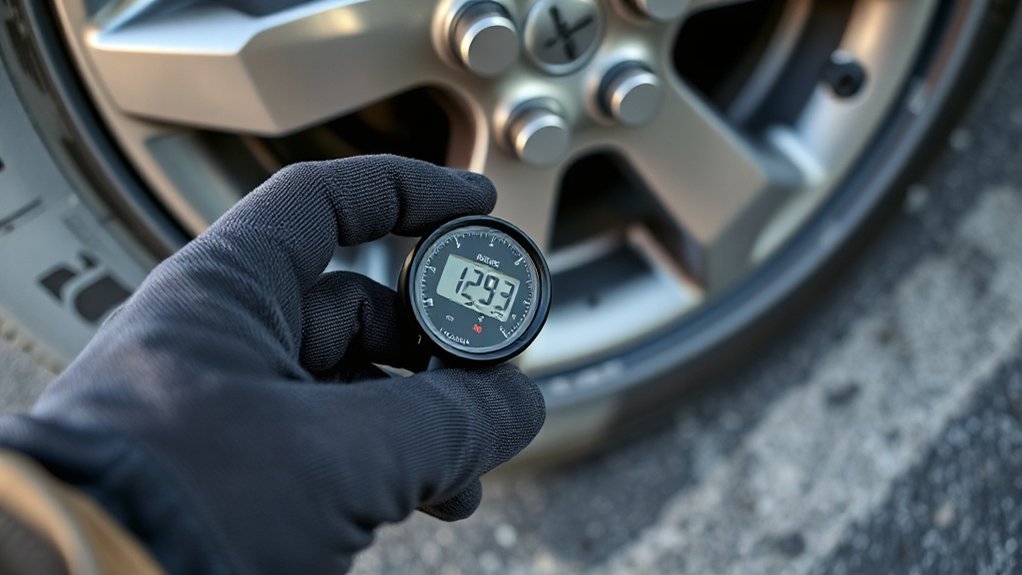
You should check your tire pressure regularly because it directly affects fuel economy, handling, and tire life. Start with cold tires, use a calibrated metal-stem hand gauge, remove the valve cap, press the gauge squarely onto the stem, and compare the result to the PSI on your door-jamb sticker or owner’s manual. If it’s off, add or release air and recheck; there are a few practical tips that make the process faster and more reliable.
Key Takeaways
- Find the vehicle’s recommended cold PSI on the door jamb sticker, fuel-filler flap, or owner’s manual before checking tires.
- Use a calibrated hand gauge, press it squarely onto the valve stem, and read the pressure with the tire cold.
- Compare the reading to the recommended PSI and add or release air in short bursts until it matches.
- Recheck pressure after inflating, replace valve caps, and repeat for all four tires (including spare if applicable).
- Check tire pressure monthly, before long trips, and whenever temperatures change significantly.
Why Tire Pressure Matters

Because tire pressure directly affects how your car handles, you should check it regularly to stay safe and efficient. You’ll notice steering response, braking distance, and cornering stability change with pressure variations; underinflation softens sidewalls, increases rolling resistance, and raises heat buildup, while overinflation reduces contact patch and grip. Maintaining correct pressure preserves tire safety by reducing blowout risk and uneven wear, letting tread perform as designed. Consistent pressure also optimizes fuel efficiency by minimizing drag on the rolling surface and preventing energy loss to flexing. Check pressure when tires are cold, inspect valves and tread, and look for bulges or cuts that indicate structural damage. Routine checks extend tire life and keep vehicle dynamics predictable.
Finding the Correct PSI for Your Vehicle

Now that you know how pressure affects handling, you need the right PSI for your specific vehicle to get those benefits. Start by checking the vehicle specifications: door jamb sticker, owner’s manual, or fuel-filler flap. Those sources list recommended cold tire pressure for front, rear, and full-load conditions. Use the listed PSI values rather than the maximum on the tire sidewall, which indicates tire capacity, not the ideal setting.
When you fill tires, match the PSI to the vehicle specifications for load and driving conditions. If you tow or carry heavy loads, follow the higher specification if provided. Record the recommended pressures for reference and label the vehicle or keep a note; that prevents guesswork and preserves handling, wear, and fuel efficiency.
When and How Often to Check Tire Pressure

Regularly check your tire pressure—at least once a month and before any long trip—so you catch slow leaks and seasonal changes early. You should follow clear frequency guidelines: inspect tires monthly, immediately after visible impact or puncture, and before carrying heavy loads. Check more often if you notice vibration, uneven wear, or fuel-economy loss. Seasonal considerations matter because temperature swings change pressure roughly 1 psi per 10°F; test more frequently during spring and fall changes. After adjusting pressure, recheck within 24–48 hours to confirm stability. Maintain a log of readings and adjustments to spot trends. If you drive rarely, check pressure before each extended drive. Use vehicle-recommended cold-pressure values as your baseline.
Checking Tire Pressure With a Hand Gauge
Use a calibrated, metal-stem hand gauge for reliable readings and avoid cheap plastic units that lose accuracy. Check pressure when the tires are cold—after the car’s been parked at least three hours or driven less than a mile—so heat buildup won’t skew the result. Keep the gauge perpendicular to the valve stem, press firmly to get a steady reading, and compare it to the manufacturer’s recommended PSI.
Choose a Quality Gauge
A reliable hand gauge gives you precise, repeatable pressure readings, so pick one built from solid materials with a clear dial or digital display and a snug-fitting chuck. You’ll choose between digital gauges and mechanical gauges; digital gauges give fast, easy-to-read results and often better resolution, while mechanical gauges (dial or stick) are durable and don’t need batteries. Inspect accuracy specs: ±1–2 psi is typical for consumer units; professional-grade tools are tighter. Check chuck fit and swivel action to avoid leaks during measurement. Prefer stainless or anodized housings, tempered glass or robust plastics for the face, and rubber-loading grips for control. Calibrate periodically against a known standard and replace any gauge that shows inconsistent readings.
Measure When Tires Cold
After you’ve picked a reliable gauge, check pressures when the tires are cold — that means the vehicle hasn’t been driven for at least three hours or has only been driven a short distance at low speed. Cold tire temperature gives a stable baseline; heat raises pressure and yields false high readings. Use the hand gauge as the primary measuring tool. Remove the valve cap, press the gauge squarely onto the valve stem, hold steady until the reading stabilizes, then record it. Repeat on all four tires and the spare if accessible. Compare readings to the manufacturer’s recommended pressure, adjusted for load. If you need to add air, do so in short bursts and re-measure. Store your measuring tools clean and calibrated for consistent results.
Using an Air Pump at a Gas Station
Most gas stations have a coin- or card-operated air pump that lets you quickly top off tire pressure; you’ll want to check the machine’s instructions and the hose for a working gauge before you begin. Use the pump’s gauge to compare PSI to your vehicle’s recommended pressure; confirm the reading by briefly re-checking with your handheld gauge. Understand basic air pump functionality: most deliver regulated pressure and shut off manually, so you control final PSI. Remove valve caps, press the hose fitting firmly, and listen for leaks. Inflate in short bursts, pausing to measure. Replace caps and stow the hose neatly per gas station etiquette. If the pump seems inaccurate or noisy, stop and use another machine or a portable inflator.
Dealing With Underinflated or Overinflated Tires
If you find a tire noticeably low or too hard, act promptly to correct pressure—underinflation raises rolling resistance and heat, while overinflation reduces contact patch and grip. Check the recommended PSI on the placard or owner’s manual, then use a calibrated gauge to confirm each tire cold. If underinflated, add air incrementally, recheck, and avoid overfilling; if overinflated, bleed air until you reach spec. Inspect tread for uneven tire wear patterns—center wear suggests overinflation, edge wear suggests underinflation—and replace tires showing structural damage. After adjustment, perform a short test drive at varied speeds to verify no handling issues like pull, vibration, or tramlining. Schedule a professional inspection if symptoms persist or if you’re unsure about wheel or suspension damage.
Conclusion
Tire pressure directly affects safety, handling, fuel economy and tire life, so keep it within your vehicle’s recommended PSI (find it on the door jamb or in the manual). Check cold tires regularly—at least monthly and before long trips—using a calibrated metal-stem hand gauge for the most accurate reading. Remove the valve cap, press the gauge squarely, record the value, then inflate or deflate to spec. Replace the valve cap and recheck to confirm correct pressure.