
You want oven-baked salmon that’s moist, flaky, and reliably cooked. Start by choosing a cut and measuring thickness; you’ll set the oven temperature accordingly. Seasoning, surface finish, and cooking skin-side down affect heat transfer and moisture retention. Precise timing and an instant-read thermometer are key—next you’ll see exact temps, times, and techniques to control doneness.
Key Takeaways
- Choose uniform, 1–1.5-inch-thick skin-on fillets or steaks for even oven cooking and easier searing.
- Roast at 375–425°F (190–220°C), adjusting time: 10–12 minutes per inch thickness for medium doneness.
- Season simply with salt, pepper, and oil, or briefly marinate 15–30 minutes; brush sweet glazes late to avoid burning.
- Use foil for moist results, parchment for gentle steaming, or broil briefly for crisp skin; monitor closely.
- Insert an instant-read probe, pull salmon a few degrees below target, and rest 3–5 minutes before serving.
Choosing the Right Salmon Cut
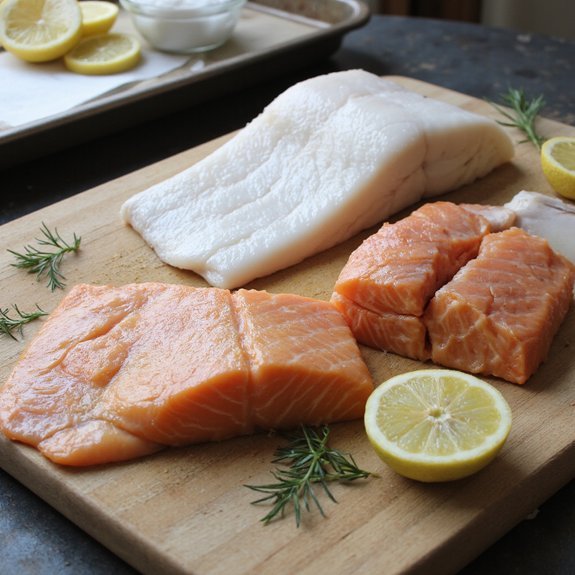
Choose a cut based on thickness, fat content, and cooking goal: for even oven cooking pick a 1–1.5-inch-thick fillet (skin-on if you want a crisp exterior and easier handling), use steaks for uniform portions and shorter roast times, and reserve whole sides when you need large servings or slower, gentler heat. You’ll decide between wild vs. farmed by evaluating oil content and texture: wild delivers leaner muscle, pronounced flavor and requires gentler handling; farmed offers higher intramuscular fat, forgiving heat. Select skin on vs. skinless according to surface-timing needs and plating: skin on protects flesh during dry heat and aids searing; skinless provides direct seasoning contact and faster marinade penetration. For portioning, target uniform thickness to standardize cook profiles; keep whole sides for slicing. You’ll optimize yield by trimming connective tissue, pin bones and belly fat while minimizing waste. Implement these decisions to streamline oven workflows and consistency.
Temperature and Timing Guidelines
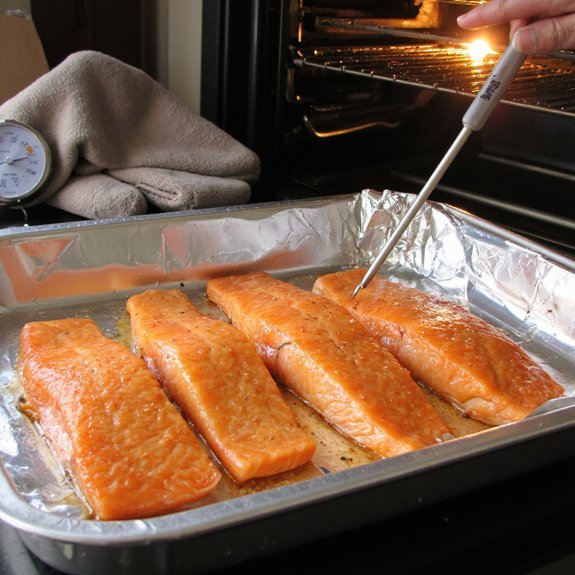
Most recipes use a narrow temperature band: roast salmon between 375–425°F (190–220°C) and adjust time by thickness and desired doneness. You’ll calibrate oven temperatures to balance Maillard development and internal carryover; aim for controlled heat rather than extremes. Use an instant-read probe to target final internal temperature precisely.
Roast salmon 375–425°F, adjust time by thickness; favor controlled heat and use a probe for precise internal temperature.
- Thin fillets (½ inch): 6–8 minutes; probe 120–125°F (49–52°C).
- Medium fillets (1 inch): 10–12 minutes; probe 125–130°F (52–54°C).
- Thick cuts/steaks (1.5–2 inches): 14–18 minutes; probe 130–135°F (54–57°C).
These cooking times assume a preheated oven and room-temperature fish. You’ll factor resting for 3–5 minutes—internal temp rises slightly—so pull salmon just below your desired doneness for consistent results. If you’re experimenting with lower-heat slow-roast profiles, reduce oven temperatures toward 300–325°F and extend cooking times; monitor internal temperature closely to prevent overcooking. For precision workflows integrate probe alarms and timed sequences to standardize yield across batches. Track metrics and adjust protocols accordingly for consistency.
Seasoning, Marinades, and Glazes
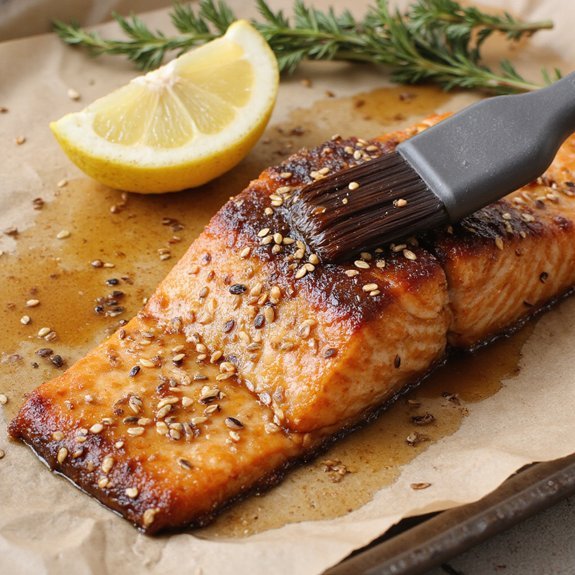
Three approaches—dry seasoning, brief marinades, and high-sugar glazes—control surface flavor, moisture transfer, and crust development. You’ll choose dry rubs for immediate salt and spice adherence; apply crystals of kosher salt, ground pepper, powdered garlic, and citrus zest to maximize ion exchange and aromatic oil release. For brief marinades, limit time (15–30 minutes) and use acid ≤10% by volume to avoid protein denaturation; include oil to moderate penetration and herbs options like dill, tarragon, or chives for volatile retention. Glazes with honey, maple, or miso concentrate sugars that caramelize above 300°F; brush late to prevent burning and balance with acid or umami. Think in flavor profiles—citrus-bright, soy-umami, herbaceous-butter—then test micro-variations on small portions. You’ll calibrate concentration, contact time, and application timing to innovate reliably while preserving salmon’s texture. Record measurements and outcomes so you can iterate reproducibly, adjusting sugar ratios, acid level, and aromatic combinations with analytical intent each time.
Cooking Methods: Foil, Parchment, and Broiling
After you’ve dialed in seasoning and glaze variables, the cooking method governs how heat and moisture interact with the fish’s surface and interior. You’ll choose sealed conduction, steam-steaming, or direct radiation.
- Foil: use foil advantages—fast conduction, sealed juices, tight fold for moisture retention.
- Parchment: parchment benefits—gentle steam, minimal fat loss, easy release for delicate texture.
- Broil: direct radiant heat for crisp skin and Maillard finish; maintain short intervals and monitor closely.
Decide by target texture and timing. Probe to 50–52°C (122–126°F) for medium-rare; carryover raises final temp. Document variables—thickness, start temp, rack distance—and iterate; small controlled changes yield measurable textural and flavor improvements. Track time and probe reads precisely. Adjust high-heat durations and tenting geometry to manipulate crust depth without overcooking; integrate aromatics inside parcels to prototype flavor layering while preserving structural integrity. Measure results, refine parameters, and codify successful routines for reproducibility systematically documented.
Serving, Storage, and Reheating Tips
When serving, plate salmon immediately or hold it briefly in a low oven (50–55°C / 122–131°F) to preserve its target interior doneness and prevent carryover from pushing it past your set point. You’ll present pieces using modular plating styles: linear for modern minimalism, stacked for texture contrast, or deconstructed for ingredient-driven innovation. Choose accompanying sides that balance moisture and acidity — quick-pickled cucumbers, charred broccolini, or a citrus-herb emulsion — to maintain thermal contrast and flavor clarity. For storage, cool salmon to room temperature no longer than two hours, then refrigerate in an airtight container; consume within 48 hours for ideal safety and texture. For freezing, flash-freeze portions on a tray, vacuum-seal, and store up to three months. Reheat gently: prefer a 120–130°C (250–265°F) oven or low-steam method until internal temperature reads 50–55°C (122–131°F); this restores warmth without overcooking. Rest briefly before serving to re-stabilize juices for plating.