
You’ll choose a well-marbled, 1–1.5-inch cut, salt it, and sear on high heat to build a crust. You’ll monitor internal temperature and aim for 130–135°F for medium-rare. Resting and carryover cooking are critical to juiciness. Keep going to learn the exact sear times, thermometer technique, and finishing moves that produce consistent results.
Key Takeaways
- Choose a tender, well-marbled cut about 1–1.5 inches thick for reliable medium-rare results.
- Pat steak dry, trim uneven fat, and salt either 1 hour before or immediately before searing.
- Preheat a heavy cast-iron skillet until just smoking to maximize Maillard browning.
- Cook until the internal temperature reaches 130–135°F (54–57°C), using an instant-read thermometer in the thickest part.
- Rest steak 5–10 minutes to redistribute juices and allow 3–5°F carryover rise to final medium-rare.
Choosing the Best Cut and Thickness
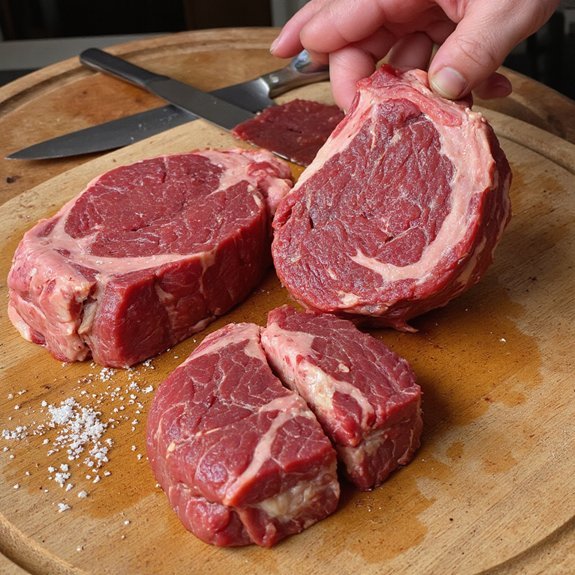
Because heat moves from the surface inward, pick a cut and thickness that match how you plan to cook it. You’ll choose between tender, fast-cooking muscles like ribeye and strip, or resilient muscles like flank and hanger that benefit from different heat profiles. For direct high-heat searing you want steaks 1 to 1.5 inches thick; for reverse sear or low-and-slow approaches, 1.5 to 2.5 inches lets you develop an even medium-rare interior without overcooking the exterior. In precision cooking, cut selection influences marbling, connective tissue, and thermal conductivity, so quantify expected carryover and target internal temperature. Use thickness matters as a rule: thicker cuts give you margin for error and temperature gradients you can exploit; thin cuts demand rapid, controlled heat. You’ll calibrate cook time to thickness and cooking method, log results, and iterate — that’s how you standardize repeatable medium-rare outcomes. Aim for consistency with measured variables.
Prepping and Seasoning the Steak
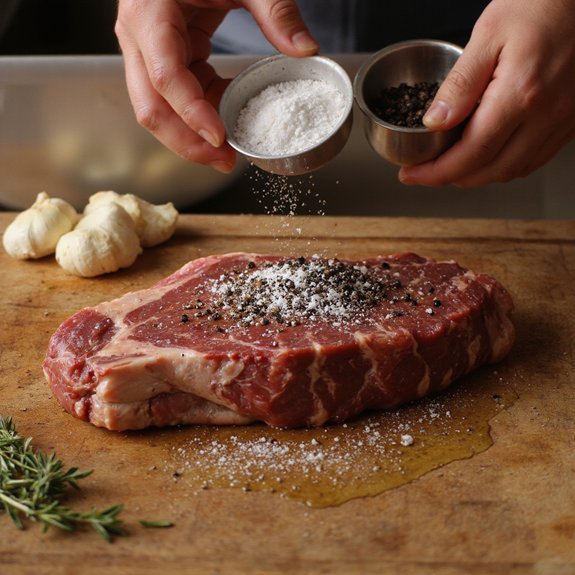
You should select a cut and thickness suited for medium-rare—ribeye or strip at about 1–1.5 inches offers predictable doneness and good marbling. You must pat the meat dry and trim excess silverskin or uneven fat so the steak makes consistent contact with the pan or grill. You should salt generously with coarse salt—either ~1 hour before cooking for modest penetration or immediately before searing for maximum crust—applying it evenly and pressing gently to adhere.
Choosing the Right Cut
One critical choice is the cut: marbling, thickness, and muscle grain dictate heat tolerance, resting loss, and the prep and seasoning strategy you’ll use. You’ll prioritize marbling importance because internal fat stabilizes temperature and flavor; choose tender cuts like ribeye or strip for medium-rare. Match thickness to cook method: thinner steaks suit quick sear, thicker ones need reverse sear or sous-vide. Consider muscle grain—cross-grain slicing improves perceived tenderness.
- Ribeye — high marbling, forgiving thermal window.
- Strip/New York — balanced fat, clear grain for precise searing.
- Tenderloin — true tender cuts, low fat, needs careful timing.
- Flank/Skirt — leaner, strong grain; reserve for marinades and fast, hot cooking.
Select a cut that aligns with your technique and desired texture; that alignment drives medium-rare results.
Drying and Trimming Meat
The first step is to get the steak dry and neatly trimmed so it sears evenly and the fat renders predictably. You’ll pat the surface with paper towels, then let it air-dry on a rack for 20–60 minutes to stabilize surface temperature; those drying methods create a Maillard-ready exterior. Use a sharp chef’s knife and employ targeted trimming techniques: remove silver skin, trim ragged edges, and sculpt excess fat into a uniform cap so heat distributes consistently. Keep trim minimal to preserve weight and flavor while ensuring even contact with the pan or grill. For innovation, consider marginal adjustments—thin fat collars or scoring thick caps—to control render rate. Work methodically; consistent prep yields repeatable medium-rare results. Document your variables to iterate toward predictable outcomes.
Salt Timing and Technique
Although salt seems simple, timing and application are what set a reliable crust and even seasoning. You’ll choose pre-salting or immediate salting based on surface moisture and desired dry-brine effect. Use coarse kosher or flake salt and precise doses per thickness.
- Pre-salt: apply salt to both sides, refrigerate uncovered 40 to 60 minutes.
- Immediate-salt: salt immediately before sear for minimal moisture draw.
- Layering: combine salt application with dry rubs after pre-salting.
- Finish-salt: light flake added post-rest for bright surface flavor.
These seasoning techniques optimize osmotic transfer and Maillard kinetics; measure salt by weight per surface area and iterate. Record variables—salt type, grams, time, temperature—and analyze results to innovate reproducible protocols that elevate medium-rare consistency across cuts and cooks. Refine continuously using controlled experiments daily.
Searing to Build a Crust
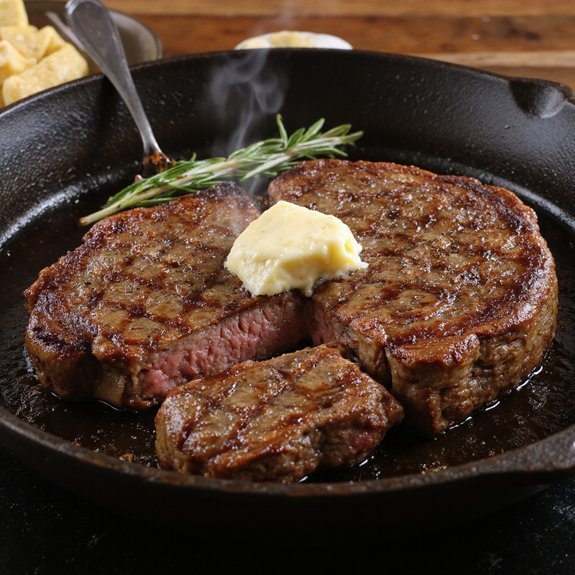
Preheat a heavy cast-iron skillet until it just begins to smoke; you’ll trigger the Maillard reaction on contact and form a tight, flavorful crust. You’ll sear with intent: pat the steak dry, season sparingly, and press to maximize surface contact. Control heat—high enough for rapid browning, low enough to avoid burning—and minimize movement to let crust development proceed. Use tongs, not forks, and finish sides for even color. For innovation, try clarified butter with a splash of high-smoke oil or a cast-iron lid to concentrate heat.
| Action | Purpose | Tip |
|---|---|---|
| Drying | Remove surface moisture | Pat with paper towel |
| Seasoning | Enhance Maillard reaction | Salt just before sear |
| Fat | Promote even browning | Use high-smoke oil |
Execute these searing techniques with confidence; the crust you build is decisive for flavor and texture. Repeat as needed for thicker cuts and adapt timing based on equipment performance. Observe and iterate with precise notes.
Cooking by Internal Temperature
You should aim for an internal temperature of 130–135°F (54–57°C) for true medium-rare. Insert an instant-read thermometer into the thickest part of the steak, avoiding bone and heavy fat, to get an accurate reading. You’ll need to pull the steak 3–5°F (1–3°C) under target to account for carryover cooking.
Target Internal Temperature
When aiming for medium-rare, set your target internal temperature to 130–135°F (54–57°C) measured at the steak’s thickest point; that range yields a warm pink center with firm but yielding texture. You’ll use that target temperature as your control parameter to engineer the perfect steak: plan sear, carryover, and resting to converge on this band. Apply precision rather than guesswork.
- Define desired doneness and margin for error.
- Account for carryover cooking and thickness variance.
- Standardize sear time and heat flux for repeatability.
- Rest to stabilize internal gradient and juice redistribution.
Operate with measured intent, iterate adjustments, and treat temperature as the design constraint. Log results, refine protocol parameters, and adopt sensor-driven automation to consistently hit the setpoint across cuts and cooks for repeatable excellence daily.
Checking With Thermometer
Having defined your target temperature, check it with a calibrated probe thermometer inserted into the steak’s thickest point, avoiding bone, gristle, and large fat pockets. You’ll rely on consistent thermometer placement: insert the probe laterally toward the center of the cut, keeping the tip at the geometric center of thickness. Guarantee proper calibration before each run—ice-point or boiling-point verification—and zero any offset. Read stable temperature readings; don’t trust transient spikes. For thin steaks, use an instant-read with shallow insertion; for thick steaks, use a leave-in probe connected to an oven or grill controller. Anticipate the carryover rise by pulling the steak a few degrees below target. Record results and adjust sear time or heat to iterate toward repeatable medium-rare outcomes. Refine based on data.
Resting and Carryover Cooking
Because residual heat keeps moving inward after searing, plan for a 5–10°F (3–6°C) rise in internal temperature and rest the steak until it stabilizes at your target doneness. You’ll use resting time to allow juices to redistribute and the carryover effect to finish precise internal development. Leave the steak on a cutting board, tent loosely with foil, and monitor with an instant-read thermometer until temperature plateaus. Follow these calibrated steps:
- Remove at 10–15°F below target.
- Tent loosely to slow surface cooling.
- Wait 5–10 minutes for equilibration.
- Verify with thermometer before slicing.
Be empirical: measure, record, iterate. For innovation, experiment with short vacuum holds or insulated rests to control thermal gradients without affecting sear. Maintain sterile surfaces and avoid compressing the steak to prevent juice loss. When temperature stabilizes at your set point, you’ll achieve consistent medium-rare with repeatable precision. Document results and refine method.
Finishing Techniques and Serving Suggestions
After the steak stabilizes at your target temperature, focus on finishing moves that preserve the sear and internal profile while adding controlled layers of flavor. You’ll want to execute rapid, low-impact interventions: a brief compound-butter glaze to introduce fat-soluble aromatics, a high-heat reverse sear flash if color needs refresh, or precise torching to lift localized crust without overcooking. For sauce pairings, select emulsions and reductions that complement the beef’s fat: a restrained red-wine demi for structure, a citrus-harissa oil for contrast, or a herbaceous chimichurri to cut richness. Slice against the grain with a smooth stroke and sequence portions to optimize residual heat. For plating presentation, prioritize negative space, verticality, and a small temperature-stable bed—roasted root purée or charred romaine—to protect doneness during service. Finish with microherbs, calibrated salt flakes, and a spray of warm clarified butter. Execute quickly; timing dictates the final doneness and the guest experience.